Midnight, Ink, and Indigo: How Blue-Black Became the Sharpest Neutral in Streetwear

For years, the urban uniform had one reliable answer: black. Black hoodie, black cargos, black boots, black cap. It was clean, it was easy, and it was everywhere. But walk through any US city right now and the black looks different. It has a blue cast. It reflects light in a way that flat black does not. It reads as ink, indigo, midnight, graphite with a cool undertone.
Blue-black is not a new color. It is a new default. And for city dressing in 2026, it is sharper than pure black because it gives monochrome somewhere to go.
What Blue-Black Actually Means
Blue-black is a family, not a single shade. At the darkest end, you have midnight: a black with a blue undertone that looks almost black indoors and slightly navy in daylight. Then ink: deep, saturated, slightly glossy, often seen in nylon and technical fabrics. Then indigo: the blue-black of raw denim, uneven and alive, fading at the seams. Then the near-blacks: charcoal with a cool cast, graphite, slate.
The point is not to wear navy. The point is to wear black that has a temperature. Blue-black is cooler, literally and visually. It feels more urban, more technical, more connected to the way city light actually works.
Why It Is Happening Now
Three things are pushing the shift. First, technical fabrics. Nylon, ripstop, and coated cottons take dye differently than wool or cotton. They often read blue-black even when the label says black. As streetwear moved further into utility and performance fabrics, the palette followed.
Second, denim culture. Raw indigo has always been a blue-black material. As loose, straight, and relaxed denim came back into the city wardrobe, the natural pairing was not a bright color. It was more blue-black: ink-toned jackets, midnight knits, charcoal tees.
Third, fatigue with flat black. Black is not going anywhere, but the all-black outfit has become so standard that it can feel like a default rather than a decision. Blue-black adds depth without adding noise. It is still monochrome. It is still sharp. It just has more to look at.
The US City Context
Blue-black makes particular sense in American cities right now because city dressing has become more layered, more practical, and less formal. You are not building outfits for a single climate-controlled environment. You are building for a train platform, a walk, an office with aggressive heating, a bar with the door propped open.
Midnight tailoring works in Washington, D.C., and New York because it reads as a suit without reading as a corporate suit. Ink-toned nylon works in Seattle and Chicago because it handles rain and wind without looking like outdoor gear. Raw indigo works in Los Angeles and Austin because it is denim, but darker and more intentional than a standard blue jean.
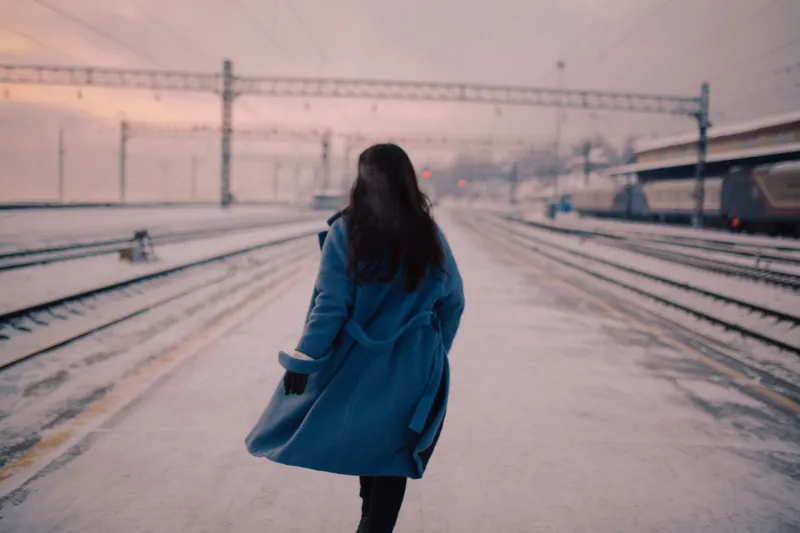
The palette also photographs well in the gray light that dominates northern winters. Pure black can go flat in overcast conditions. Blue-black picks up the ambient light and keeps its shape.
How to Layer Near-Black Shades
The mistake is to treat blue-black as one color. It is not. You need contrast, but the contrast comes from shade and texture, not from a bright accent.
Start with one anchor. A midnight wool coat, an ink nylon bomber, or a pair of raw indigo jeans. Build the rest of the outfit in shades that sit one or two steps away. If the anchor is midnight, use charcoal for the knit and true black for the boot. If the anchor is raw indigo, use ink for the jacket and graphite for the tee.
Keep the contrast subtle. A midnight coat over a black turtleneck over charcoal trousers is enough. You do not need a white sneaker to break it up. In fact, the absence of a bright break is the point.
Use sheen as a tool. Matte wool next to glossy nylon. Raw denim next to a smooth technical fabric. A faintly reflective hardware detail on a bag or a zipper. Blue-black looks best when the light catches different surfaces at different angles.
Styling Notes for Streetwear
For streetwear, the easiest entry is an ink-toned nylon jacket over a black hoodie and raw indigo denim. Keep the boots black. Keep the cap charcoal or midnight. Let the denim be the loudest thing in the outfit, even though it is still dark.
For a sharper look, try midnight tailoring: a blue-black blazer or overcoat, a black merino turtleneck, and charcoal straight-leg trousers. This is not a business suit. It is a city suit, which means it can handle a sneaker or a boot depending on the day.
For tonal hardware, look for matte black or gunmetal. Bright silver can work, but it pulls the outfit toward a more traditional menswear register. Gunmetal keeps it cool.
Avoid the trap of wearing too many blues. Blue-black is not an excuse to wear navy, cobalt, and indigo together. Stay in the near-black range. If you can tell the color from across the street, it is probably too blue.
The Contrast Problem
The biggest question with blue-black is contrast. If everything is dark, does the outfit disappear? In practice, no, as long as you vary texture and shade. The eye reads the difference between a matte charcoal knit and a glossy ink jacket even when the colors are close.
The place to be careful is the bottom half. If the trouser and the boot are the same blue-black, the leg can look like one long block. Add a slight break with a charcoal sock or a different texture. Raw indigo against black leather is usually enough.
The New Monochrome
Blue-black is not a rejection of monochrome. It is a refinement of it. It keeps the discipline of a dark palette but adds depth, temperature, and a little more life. For US city dressing in 2026, that feels right. The streets are gray, the light is flat, the commute is long. A blue-black wardrobe gives you something to look at without asking for attention.