Half an Inch, Whole Different Fit: Five Blue-Black Trouser Lengths, Decoded
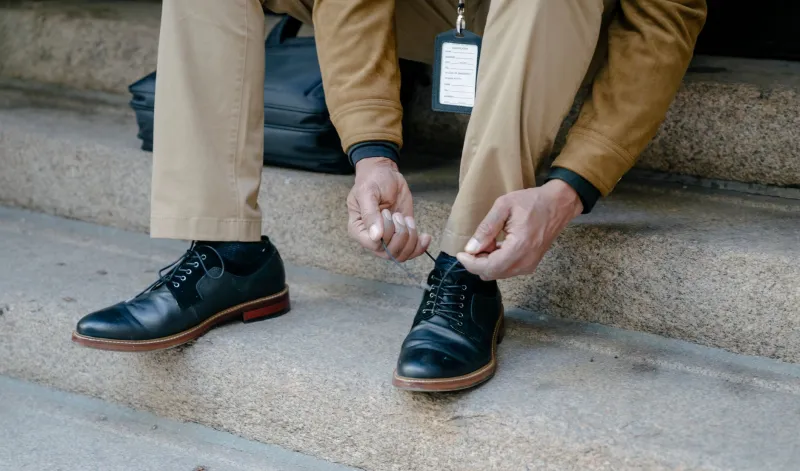
Nobody buys trousers for the hem. They buy for the waist, the rise, the fabric, the price. Then they get the trousers home, put them on, and something is off — and nine times out of ten the something is the last inch and a half.
With blue-black specifically, the hem matters more than it does in any other color. Midnight and ink hold a crease, catch light, and show every break. A single fold stacking wrong at the ankle reads loud in a way it wouldn't in mid-gray. Which is convenient, because it means you can fix an entire silhouette for about the price of lunch.
Why blue-black is fussier at the ankle
Dark, saturated fabric absorbs light, so a clean line looks sharper — and a sloppy one looks sloppier. There's no mid-tone to hide a crumpled break. Blue-black also tends to photograph with more contrast than pure black, which is great for a photo and unforgiving on a Tuesday morning when you're running for a train.
So the length you choose has to be matched to the shoe, the sock, and the weight of the cloth. Here are the five.
Full break
One substantial fold resting on the shoe, with the hem grazing the top of the laces.
This is the most traditional option and the most forgiving to buy off the rack — most trousers arrive here. It reads dressy-casual, slightly older, and works best with a heavier fabric (10–12 oz wool, brushed twill) and a shoe with real volume, like a derby or a chunky boot.
Risk: in a lightweight blue-black, a full break creases permanently and turns shiny at the fold. If you want this length, buy the heavier cloth.
On a train: fine. On a wet sidewalk: the hem takes the splash. Get it hemmed with a slightly deeper turn-up — an inch and three-quarters rather than the standard inch — so there's fabric to let down after a season of salt.
Quarter break
The hem touches the shoe with one soft crease. Nothing piles up.
This is the safest sharp look and the one most people actually want. It works with almost any shoe, any weight, and any commute. Blue-black at a quarter break reads clean and slightly modern — closer to streetwear than suiting but not obviously either.
Socks matter here. A quarter break makes a visible sliver of sock likely when you sit or step up onto a curb, so either match the trouser tone or commit to a deliberate contrast in a dark charcoal.
No-break
The hem stops just at the top of the shoe, no fold at all. A hair of sock shows when you walk.
This is the current sweet spot for blue-black. It reads intentional, works with slim-straight and tapered cuts, and takes a low-profile sneaker or a sleek boot without argument. It also keeps hems out of slush, which is not a small thing if you live somewhere with a real winter.
It's less forgiving. A no-break needs a clean taper below the knee, or it looks like a mistake. And it needs the right shoe volume — a big toe box under a no-break reads clumsy.
Cropped
One to two inches above the shoe, designed to show sock or ankle on purpose.
Cropped blue-black trousers are the most streetwear-coded of the five, and the most dependent on the rest of the outfit. Get it right and it looks like a full look; get it wrong and it looks like your trousers shrank.
Rules of thumb: crop with a straight or wide leg, not a skinny one. Commit to the sock — a ribbed dark crew, not a hidden no-show. And keep the crop consistent on both legs; asymmetry here reads as error, not style.
Stacked
Extra length, pooled in deliberate folds over the shoe.
Stacking is a styling decision, not a fit failure — but only when it's controlled. It needs a soft, drapey fabric (washed cotton, fluid twill), a substantial shoe to catch the fabric, and a straight-to-wide leg. Blue-black stacks well because the folds catch light and create a ribbed, tonal texture.
It does not work in stiff worsted wool, and it does not work with a slim taper. And it needs maintenance: a stacked hem collects grit and needs pressing more often than any of the others.
Shoe volume and sock math
A quick way to think about it: the wider the shoe, the more hem the shoe can carry. Chunky sneakers and lug boots absorb a full break or a stack. Low-profile leather sneakers and slim boots want no-break or a quarter break. A cropped length wants volume beneath it, or it reads top-heavy.
Socks are part of the length, whether you like it or not. Dark socks extend the leg line and let you get away with a shorter hem. Light socks cut the line and make a no-break read as a flood. If you want one rule to live by: match the trouser, not the shoe.
Fabric weight changes the number
Lightweight cloth (under 8 oz) needs to be shorter than you think — it has no weight to pull the crease out. Mid-weight (9–11 oz) is the honest zone where a quarter break behaves. Heavy cloth (12 oz and up) can carry a full break without turning into a puddle, but will not stack cleanly unless it's been washed soft.
The checklist to hand your tailor
Walk in wearing the shoes you'll actually wear with the trousers. Then say this:
- Pin, don't chalk from memory. Have them pin with you standing and then sitting, so you can see where the hem lands on the shoe.
- State the length by name. Say "quarter break" or "no-break" — most tailors know these terms and it's faster than pointing at a mirror.
- Ask for a 1.75-inch turn-up unless you're stacking. It gives you room to let down after a wash or a season.
- Keep the original hem if it's finished. If the trousers came with a stitched hem, ask them to preserve it and reattach at the new length. It costs a few dollars more and looks correct.
- Match the thread. Blue-black fabric needs a matching or slightly darker thread; standard black thread on navy-black cloth can read as a visible line.
- Check both legs while walking. Hem one, put the shoe back on, take ten steps. Folds only show up in motion.
- Budget $20–$35 per pair. Anything dramatically cheaper usually means a fused, taped finish that will fall apart.
Half an inch, one tailor visit, and suddenly the trousers you almost returned are the ones you reach for. That's the whole argument. The hem is the fit.